
Shipping an Electric Vehicle: What Is Different
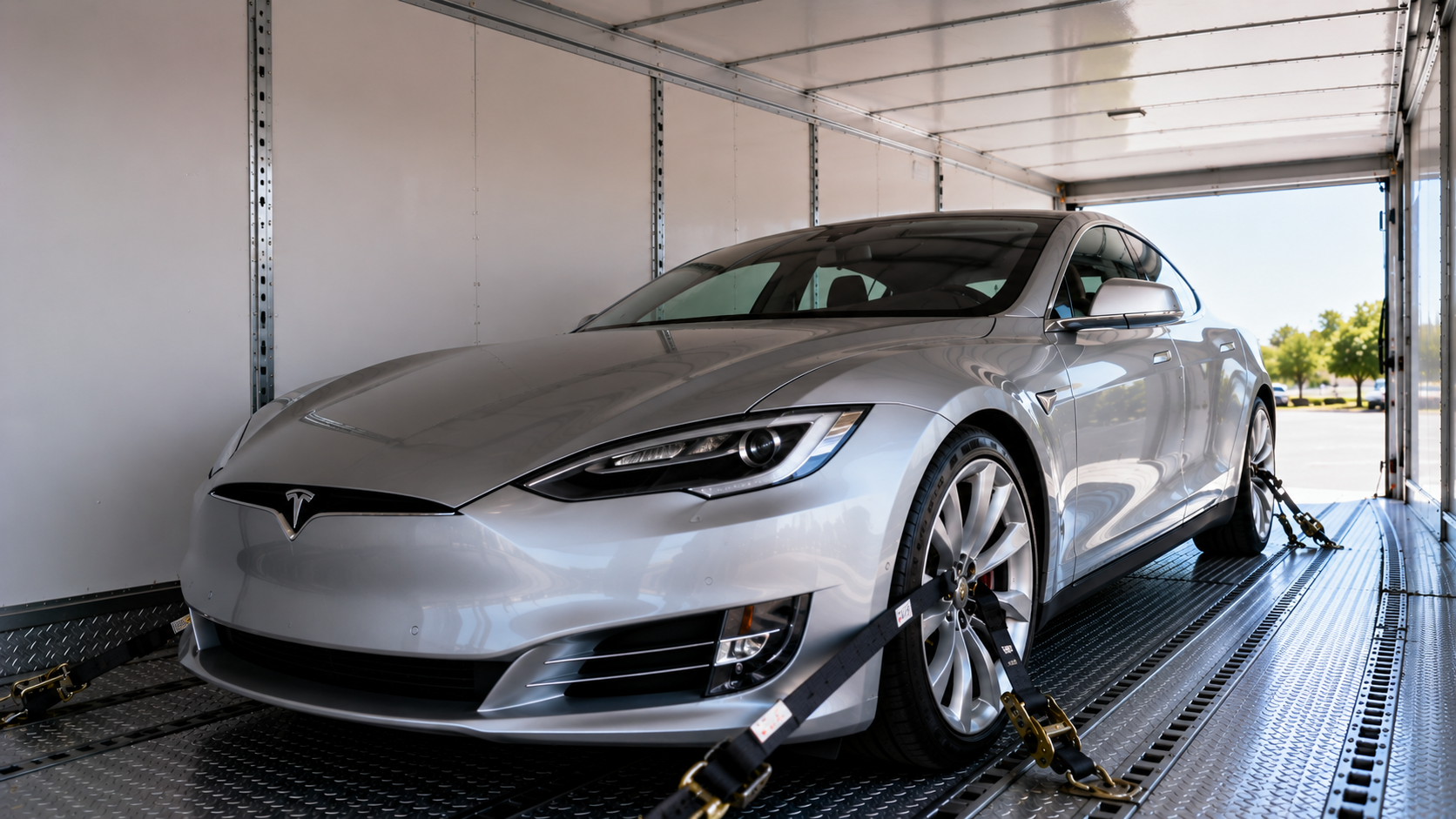
Electric vehicles weigh more, ship differently, and carry a higher average value than their gasoline counterparts. If you need to ship an electric car across state lines, the core transport process is the same—your vehicle rides on an open or enclosed auto carrier—but preparation, carrier requirements, and cost factors all shift because of the battery pack. Understanding these differences before you book will help you choose the right service level and avoid surprises at pickup.
Battery Weight Changes the Cost Equation
A mid-size electric sedan typically carries 800 to 1,200 pounds of lithium-ion cells under the floor. That battery mass pushes total vehicle weight well above a comparable gasoline model, and transport pricing reflects it. Carriers calculate loads by both vehicle count and total weight; a trailer filled with heavy EVs reaches its weight ceiling faster, limiting how many cars the driver can legally haul on that run.
Our Cost Index shows open transport averaging around $1.32 per mile in 2026, with short hauls climbing to roughly $1.93 per mile and long hauls tapering to about $0.85 per mile. Because an EV consumes more of the trailer’s weight allowance, your quote may land toward the higher end of the range for your mileage, especially if you’re shipping a large SUV or truck with a dual-motor powertrain. Diesel fuel prices—tracked weekly by the U.S. Energy Information Administration—and the Bureau of Labor Statistics truck-transportation Producer Price Index also influence what carriers charge, but weight remains the most direct EV-specific factor.
When you request a quote, the broker will ask for year, make, and model. Be precise; a base trim and a long-range or performance variant can differ by several hundred pounds, and that difference matters when the dispatcher builds the load.
Charge Level and Battery Prep
Carriers ask you to deliver your gasoline car with a quarter tank or less to reduce fire risk and weight. The same safety principle applies to electric vehicles, but the execution is simpler: aim for a state of charge between twenty and fifty percent at pickup.
A twenty-percent floor ensures the vehicle can roll on and off the trailer under its own power if the driver needs to reposition it at a fuel stop or during unloading. Fifty percent leaves a comfortable margin below the maximum, which matters because a fully charged lithium-ion pack stores significant energy. Keeping the charge in the mid-range also avoids the battery-management system entering a deep-discharge protection mode during transport, which can complicate delivery if the car refuses to shift out of park.
Before the carrier arrives, verify that your key fob or PIN will wake the vehicle and release the parking brake. Some EVs lock certain functions when the 12-volt accessory battery sits unused for days; if your model has a transport or service mode, consult the owner’s manual and enable it. Drivers are trained to handle electric powertrains, but they are not manufacturer technicians. The smoother the handoff, the faster your pickup.
When to Choose Enclosed Transport
Most electric vehicles ship safely on open trailers. The battery pack sits in a sealed, crash-protected enclosure; road spray and weather will not harm it. But three scenarios push buyers toward enclosed transport: high vehicle value, new-car condition, and long-distance moves through harsh climates.
Enclosed transport runs roughly sixty percent higher than open, according to our Cost Index. That premium buys a hard-sided trailer, typically carrying four to six vehicles instead of eight or nine, with no exposure to road debris, salt spray, or hail. If you’ve just taken delivery of a high-value or limited-production EV and plan to ship it across the country, enclosed service protects both the exterior finish and your resale value.
Enclosed carriers also climate-control their trailers or offer better temperature stability. Lithium-ion cells perform best between fifty and eighty degrees Fahrenheit. While a battery will not fail during a winter crossing on an open deck, keeping it out of sub-zero wind and summer desert sun reduces stress on the pack. For a brand-new vehicle still under factory warranty, that extra care can matter.
Insurance Coverage and Declared Value
Every licensed motor carrier is required to carry cargo insurance, and that policy covers your vehicle during transit. When you book, the broker or carrier will ask for the current market value of your EV. This declared value sets the ceiling for any damage claim, so use the actual replacement cost—check your own auto-insurance declaration or a recent appraisal if the vehicle is modified or rare.
Do not assume your personal auto policy’s comprehensive coverage extends to over-the-road transport; most exclude commercial carriage. The carrier’s cargo policy is your primary protection. Read the insurance certificate the broker provides, confirm the coverage limit meets or exceeds your car’s value, and verify that the carrier holds an active U.S. Department of Transportation number. If your EV’s value exceeds the standard cargo limit, ask whether you can purchase supplemental coverage or whether you need to arrange a separate inland-marine policy through your own insurer.
Document condition before pickup. Photograph all panels, the windshield, the charge port, and the underbody if accessible. Electric vehicles often have smooth lower aero panels; a crack or scrape there is easier to miss during a walk-around, but it can be expensive to replace.
Charging Infrastructure and Delivery Timing
One question we hear often: will the driver recharge my car en route? The short answer is no. Auto carriers run on tight schedules, and finding a charging station with trailer clearance, then waiting thirty to sixty minutes for a meaningful charge, disrupts the load plan. Drivers will not plug in your vehicle unless you’ve arranged it explicitly in advance and the route allows time for it—and even then, expect an additional service fee.
Instead, prepare your EV with enough charge to drive onto the trailer at origin and off at destination. If you’re shipping to a remote area with limited public charging, communicate that to the broker. Some carriers can deliver to a location within a few miles of a charger, letting you drive the final leg yourself, rather than leaving the car stranded at a lot with no way to move it.
Delivery timing also shifts slightly for EVs. Because weight restrictions mean fewer cars per load, some routes see less frequent electric-vehicle shipments. If you’re on a deadline, mention it when you book; express or guaranteed-pickup service costs more but locks your slot and ensures the truck arrives on your schedule.
Carrier Experience and Equipment
Not every auto hauler specializes in electric vehicles, but any professional driver can transport one safely if the car is prepped correctly. The industry has adapted as EV sales have grown; training programs now cover high-voltage safety, battery-disconnect procedures, and emergency response for thermal events, though actual fires remain statistically rare.
When you work with a broker, ask whether the carriers in their network have transported your specific make and model before. Some heavy or low-clearance EVs—especially performance variants with wide tires and low front splitters—require trailer ramps with a gentler angle or additional deck height. A carrier familiar with your vehicle will know to bring wheel chocks, skates, or a winch if the car sits too low to clear the standard ramp.
Enclosed carriers tend to see more high-end EVs, so their drivers often have deeper experience with air-suspension modes, transport locks, and charging-port covers. If your vehicle has unique loading requirements, mention them in the booking notes; the dispatcher can match you with a driver who has handled similar cars.
Get your instant car shipping price
Real quote in seconds. Enter your details and we’ll show your price instantly.
No spam — we only use this to send your quote and confirm your booking.
Frequently Asked Questions
Do I need to disable my EV’s alarm or tracking system before shipping?
Yes. If your vehicle has an anti-theft alarm that triggers from motion or tilt, disable it or set it to transport mode. GPS tracking can stay active, but notify your monitoring service that the car will be in transit so they don’t flag it as stolen when it crosses state lines.
Can I leave my charging cable in the car during transport?
You can, but remove it from the trunk or frunk and secure it so it won’t shift and scratch interior panels. Carriers allow minimal personal items, and a factory charging cable falls within that limit. Do not leave aftermarket cables or adapters worth more than minimal value; cargo insurance covers the vehicle, not loose accessories.
Will cold weather during transport damage my EV battery?
No. Lithium-ion packs are designed to withstand freezing temperatures when the vehicle is off. The battery-management system will prevent charging or discharging below safe thresholds. Once you take delivery, let the pack warm to ambient temperature before attempting a fast-charge session to avoid reduced acceptance rates.
How do I ship an electric vehicle that is not drivable or has a software fault?
Book the shipment as inoperable. The carrier will use a winch to load the vehicle, which adds to the cost and requires advance notice. If the fault is software-related and the car can still roll in neutral, confirm that with the driver at pickup to avoid an unnecessary inoperable fee.
Does shipping an electric car cost more than shipping a gasoline car of the same size?
It can, because the battery weight reduces how many vehicles the carrier can legally haul on one trailer. The difference is usually modest—your quote reflects the specific route, season, and current fuel costs—but expect pricing at the higher end of the range for your distance, especially for large or heavy EVs.
Ready to ship your electric vehicle? Get an instant quote tailored to your specific make, model, and route at Simple Car Ship. Our network of vetted carriers handles EVs every day, and our team will walk you through prep, timing, and service options before your pickup date.