
How Much Does It Cost to Ship a Car from Illinois to Connecticut?
Shipping a car from Illinois to Connecticut typically costs between $1,190 and $1,445 for open transport, or $1,900 to $2,315 for enclosed transport across the 895-mile route. Your final price depends on your vehicle type, trailer choice, seasonal demand, and how flexible you are with pickup timing. Here’s exactly what moves the number—and what you’ll pay for this corridor.
Get your instant car shipping price
Real quote in seconds — no spam, no runaround.
What You’ll Pay: Open vs. Enclosed Transport from Illinois to Connecticut
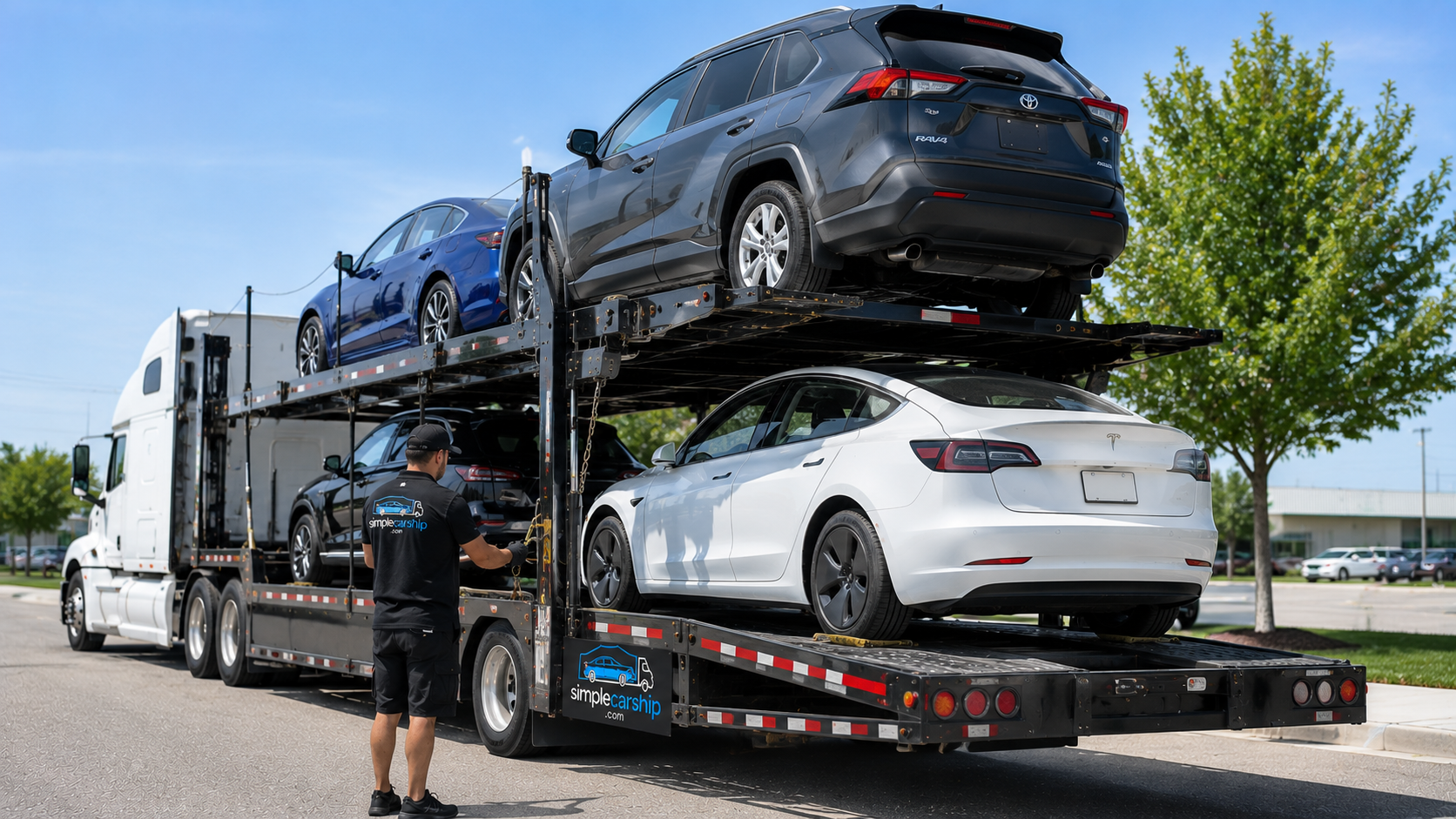
Open transport—the kind you see rolling down I-80 with cars stacked on two levels—runs $1,190 to $1,445 for the Chicago–Hartford corridor. It’s the workhorse option: safe, insured, and how roughly 85% of vehicles move cross-country. Your car rides exposed to weather, but carriers do this every day and damage claims are rare. If you’re shipping a daily driver, a lease return, or a recent trade-in, open transport delivers the best value.
Enclosed transport wraps your vehicle inside a covered trailer and costs $1,900 to $2,315 for the same route. You’re paying for walls, a roof, and often single-level loading, which means no overspray from road salt, no highway debris, and white-glove handling. This makes sense for classics, European sports cars, or anything with a paint job you’d rather not test against an early-spring Midwest dust storm. The price gap reflects both the equipment and the fact that enclosed trailers carry fewer cars per run, so per-vehicle costs climb.
How Distance, Timing, and Vehicle Details Move the Price
The 895-mile span from Illinois to Connecticut sits in a pricing sweet spot: long enough that per-mile rates drop compared to short hops, but direct enough that carriers don’t need complex multi-stop routing. That said, pickup flexibility is the single biggest lever you control. A “first available” window lets dispatchers slot you into the next eastbound carrier with open deck space, often shaving $100–150 off your quote. Tight date demands—especially “must pick up Tuesday”—force brokers to chase specific trucks, and that urgency costs you.
Vehicle size and operability matter, too. A standard sedan fits the baseline quote. A lifted Silverado or a Suburban takes more deck height and may push you toward the higher end of the range. Inoperable vehicles require a winch load, adding $75–150 depending on the carrier. If your car doesn’t start, roll, brake, or steer, flag it up front—surprises at pickup turn into renegotiations and delays.
Seasonal demand plays a smaller role on this route than on Sun Belt corridors, but late spring and early fall see modest upticks as college students move and corporate relocations cluster. Winter is generally quiet, though a surprise January snowstorm in the Chicago metro can delay dispatch by a day or two. Prices don’t swing wildly, but expect quotes $50–100 higher during May and September peaks.
Pickup in Illinois, Delivery in Connecticut: Metro Coverage and Logistics
Most Illinois pickups happen in the Chicago and Naperville area, where carrier density is high and trucks pass through daily on transcontinental lanes. If you’re outside the metro—say, Rockford or Peoria—expect the carrier to ask you to meet at a nearby truck-friendly lot or major intersection. This isn’t a runaround; 53-foot trailers simply can’t navigate every cul-de-sac or gravel driveway, and meeting halfway keeps your price down and schedule predictable.
On the Connecticut end, deliveries concentrate in Hartford and Stamford, with good access to New Haven, Bridgeport, and the I-91/I-84 corridors. Stamford’s proximity to the New York metro means carriers often run this route as part of broader Northeast loops, which improves truck availability. If you’re in a rural Litchfield County town or up near the Massachusetts line, coordinate a meeting point early—your driver will appreciate it, and you’ll avoid last-minute scrambles.
Transit Time: How Long Illinois to Connecticut Actually Takes
Expect your car to arrive in 1 to 3 days after pickup. The 895-mile shot runs primarily along I-80 through Indiana, Ohio, and Pennsylvania before cutting northeast into Connecticut—a well-traveled freight artery with minimal bottlenecks outside of occasional weather or roadwork. Single-driver carriers typically complete the trip in one long push or an overnight split; team-driver expedited services can deliver next-day if you’re willing to pay the $1,937 express premium.
That said, “1 to 3 days” starts the clock at actual pickup, not quote acceptance. Dispatch—matching your car to an available carrier—takes anywhere from 1 to 5 days depending on season, route demand, and how flexible your window is. If you need your vehicle by a hard deadline, book 10–14 days out and communicate the date up front. Carriers appreciate lead time, and you’ll have fallback options if the first truck fills up.
How Simple Car Ship Handles the Illinois–Connecticut Corridor
We built Simple Car Ship because the broker model was broken—load boards full of strangers, voicemails that go nowhere, and quotes that evaporate when you’re ready to book. Here’s what you get instead: a real human walks you through the quote, explains why the price is what it is, and answers the questions you didn’t know to ask. Once you book, we hand-select a carrier from our vetted network—licensed, insured, and experienced on Midwest-to-Northeast runs—then introduce you directly. No game of telephone.
Your shipment isn’t a load number lost in a dispatch queue. We track pickup and delivery, flag delays before they become problems, and stay reachable by text or phone until your car is in your driveway. Transparent pricing, clear communication, no runaround. That’s the simple way.
| Feature | Open Transport | Enclosed Transport |
|---|---|---|
| Price (IL–CT) | $1,190–$1,445 | $1,900–$2,315 |
| Transit Time | 1–3 days | 1–3 days |
| Protection | Insured; weather-exposed | Fully enclosed; premium handling |
| Best For | Daily drivers, recent models, cost-conscious moves | Classics, luxury, high-value or custom vehicles |
Open or Enclosed? Choosing the Right Trailer for Your Illinois–Connecticut Move
If your car is a leased Accord, a used Camry, or anything you’d park at the airport without a second thought, open transport is the call. It’s how dealerships move inventory and how snowbirds ship SUVs to Florida every November—proven, reliable, and priced fairly. Carriers secure vehicles with wheel straps and chains, insurance covers the transit, and the odds of damage are statistically tiny. Save the enclosed premium for something that genuinely needs it.
Go enclosed if you’re moving a Porsche 911, a restored Mustang, a Tesla Model S Plaid, or anything with aftermarket paint, lowered suspension, or six-figure value. The peace of mind—and the protection from road grime, spring rain, and the occasional rock chip—justifies the extra $700–900. Enclosed carriers also tend to offer more flexible delivery windows and white-glove communication, because their clientele expects it. You’re not just buying walls; you’re buying a higher service tier.
Ready to Ship? Get a Clear Quote for Your Illinois–Connecticut Move
No runaround, no bait-and-switch, no mystery fees. Tell us your vehicle, your cities, and your timeline, and we’ll show you exactly what it costs—and why. Real quotes from real carriers, backed by human support from quote to delivery. Get your quote now and ship your car the simple way.
Frequently Asked Questions: Shipping a Car from Illinois to Connecticut
What’s the average cost to ship a car from Illinois to Connecticut?
Open transport averages $1,190 to $1,445 for the 895-mile route between Chicago-area and Hartford/Stamford metros. Enclosed transport runs $1,900 to $2,315. Your final price depends on vehicle size, pickup flexibility, and seasonal demand. Booking with a flexible window typically lands you near the lower end of the range.
How long does it take to ship a car from Illinois to Connecticut?
Transit takes 1 to 3 days after pickup along the I-80 corridor. Dispatch—finding and assigning your carrier—adds 1–5 days depending on season and route demand. For a firm delivery date, book 10–14 days in advance and communicate your timeline up front so the carrier can plan accordingly.
Is open transport safe for the Illinois–Connecticut route?
Yes. Open transport is how 85% of vehicles move cross-country, including dealer inventory and fleet cars. Carriers secure your car with wheel straps, and every load is insured. Weather exposure is minimal on this route, and damage claims are rare. Unless your car is high-value or custom, open transport is both safe and cost-effective.
Do carriers pick up and deliver to residential addresses?
Most carriers can reach residential streets in Chicago, Naperville, Hartford, and Stamford metros, but large trailers struggle with tight cul-de-sacs, low-hanging trees, or narrow driveways. If your location isn’t truck-friendly, the driver will ask you to meet at a nearby shopping center or major intersection. Coordinate early to avoid delays.
Can I ship an inoperable car from Illinois to Connecticut?
Yes, but flag it when you book. Inoperable vehicles require winch loading, which adds $75–150 to your quote depending on the carrier. “Inoperable” means the car won’t start, roll, brake, or steer. If it only has a dead battery or minor issue, clarify with your coordinator—you may avoid the surcharge.
Should I choose expedited shipping for this route?
Expedited service costs $1,937 for open transport and guarantees faster dispatch plus potential next-day delivery via team drivers. It makes sense if you’re flying into Connecticut and need the car immediately, or if you sold a vehicle with a firm handoff date. For most moves, standard 1–3 day transit with early booking is sufficient.